

 2 »
2 » 0
0

Comments are only allowed for registered users.
Before you insert your comment, you have to log on or register.

451.045-9 | |
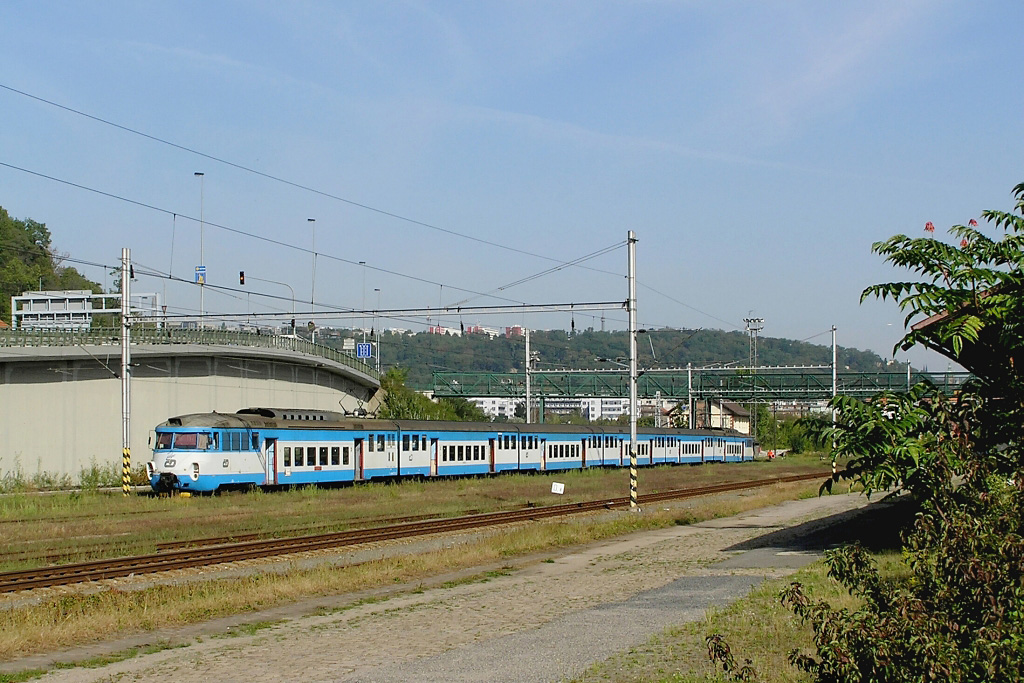 | Informace o fotografii: - Place: Praha-Smíchov (Praha Smíchov - společné nádraží) - Datum: 7.9.2006 - By: MirKo - Comm.: odpočívající berounské Talgo - Zobrazeno: 2580x - Detailní EXIF informace » - Rating od autorů: 4 - Rating od uživatelů: 5 |
| Abyste mohli hodnotit, musíte se přihlásit | |
05.11.2007 (15:57)
Thanks a lot, Chary!
The explanation has been much clear. :)
Greetings from Bilbao
Jon
The explanation has been much clear. :)
Greetings from Bilbao
Jon
Hi Jon,
CD class 451 is originally designed as motor-car-car-motor. For track around Prague, with almost no rising, there has been coupled this motor-car-car-car-car-motor unit. One third more capacity with only still two engine cars. It would have problems in hilly tracks, but in the flatland it is just ok. The engine bogies are equipped with selfcooling high-revolution-speed engines that expect a "light" train set and therefore quick acceleration with sufficient cooling. Heavy train would not be able to accelerate quick enough to cool the engines on a rising track.
Since it is quite unusual coupling for class 451 (which is more likely to be coupled only motor-car-motor for routes with less passanger capacity need), and for the slight resemblance with original Talgo sets (long sets with many cars), it is called "Talgo", by engineers and maintenace personnel.
Hope you will understand it.
CD class 451 is originally designed as motor-car-car-motor. For track around Prague, with almost no rising, there has been coupled this motor-car-car-car-car-motor unit. One third more capacity with only still two engine cars. It would have problems in hilly tracks, but in the flatland it is just ok. The engine bogies are equipped with selfcooling high-revolution-speed engines that expect a "light" train set and therefore quick acceleration with sufficient cooling. Heavy train would not be able to accelerate quick enough to cool the engines on a rising track.
Since it is quite unusual coupling for class 451 (which is more likely to be coupled only motor-car-motor for routes with less passanger capacity need), and for the slight resemblance with original Talgo sets (long sets with many cars), it is called "Talgo", by engineers and maintenace personnel.
Hope you will understand it.
02.11.2007 (15:59)
First of all, I must apologize, since I can't speak czech, and I've got to try English (and my English is neither very good).
I'm an spanish railfan, watching with surprise this Talgo logo at the unit. Could anyone tell my how did it get there? Is Talgo working with CD?
Thank you in advance.
Jon
I'm an spanish railfan, watching with surprise this Talgo logo at the unit. Could anyone tell my how did it get there? Is Talgo working with CD?
Thank you in advance.
Jon
Co se mi na fotce líbí je to, že původní vzhled nekazí jediné oranžové dveře.
11.09.2006 (13:25)
super. 5*
11.09.2006 (10:48)
Dobré na tom je, že jak je to zachycené z dálky, tak aspoň nejsou uřezané brány trolejového vedení - a navíc to obvzláštňující "mandarinka" vzadu u žabí tlamy, vypadá to zajímavě.
11.09.2006 (8:38)
moc z dalky ale to by tam zase nebyla cela suprava 3,5*
Comments are users' expressions.
ŽelPage has no liability for their contents.
 - Registered Photograph or Member of ŽelPage,
  - Gallery or ŽelPage Administrator
Add comment
Sign in
© 2001 - 2026 ŽelPage
- Webmaster - Frequently Asked Questions

:. Projects
:. Websites
:. Contacts
:. Sledujte nás


Info

informacni okenko